



As it oversees North America’s first gas-to-liquids facility, Cerilon is in a unique position to enable the continent’s energy transition. We sit down with CEO, Nico Duursema, who reflects on how the company is creating a new domestic source of energy products from natural gas, reducing national reliance on foreign imports, and providing environmentally cleaner products.
Q&A WITH NICO DUURSEMA, CEO, CERILON
Firstly, what is your take on the energy industry in North America today, and how have you seen it evolve over the course of your career with Cerilon?
Nico Duursema, CEO (ND): The energy industry is facing a number of unprecedented challenges, including responding to and leveraging new and rapidly changing technology, increased environmental responsibilities and regulatory scrutiny, recruiting and retaining talent, and aligning with evolving societal expectations about how energy is produced and used.
The convergence of these challenges is disruptive and complex and necessitates new business models, tools, and thinking.
In a world full of change and uncertainty, it is of utmost importance that we communicate a clear vision, embrace our values, and adapt for the future by adhering to fundamental principles, aligning with like-minded partners, and focusing on new skills and competencies.
I view these challenges as opportunities for those willing to take ownership of their future. Those who have the courage to lead through rapid change, act as good stewards of our resources and the environment, and approach their efforts with excellence will succeed in the energy industry today.
We must focus on what’s possible, take accountability for achieving our objectives, and be ready to make decisions quickly.
Right now, we are experiencing a very positive business environment in North America that is aimed at supporting growth, but the turbulence of rapid change remains. We must shift from old ways of thinking – especially on the eve of rapid artificial intelligence (AI) expansion – and change the way we do business.
The new technology era we are entering challenges regulators, political decision makers, and industry organizations to provide the guidance and governance needed to manage this change effectively and efficiently. It is also straining existing infrastructure that needs to be updated and expanded to accommodate the computing capacity needs we are already seeing.
In my view, all of this creates unprecedented opportunity for companies like Cerilon with a strong vision for the future and the ability to deliver.
We see significant opportunity for us to be a leader in the energy transition by providing industry leading thinking, tools, and products.
As a company delivering high performing products to the agricultural, industrial energy, digital, defense, and transportation industries, could you provide an overview of Cerilon and its role in North America’s energy transition?
ND: Our role in North America’s energy transition comes from the products we produce and how they are used, as well as how we integrate technology into our business.
Cerilon’s products offer improved environmental performance and have applications across key industries including agriculture, defense, transportation, and the rapidly expanding digital infrastructure business.
Our advanced digital integration platform is creating a strategic solution for not only our North Dakota facility but also for any industry with complex data management needs. For these reasons, Cerilon is well-positioned to play a key role in the energy transition.
We will be the first large scale producer of gas-to-liquids (GTL) Group III+ base oils in North America and will reduce the need to import these products.
Top-tier GTL Group III+ base oils have a number of important attributes that position them to play a critical role in the energy transition.
The incorporation of carbon capture storage (CCS) results in Cerilon GTL base oils having the lowest carbon footprint of all GTL facilities globally.
This, combined with additional greenhouse gas (GHG) reduction benefits during their use, results in substantial GHG savings compared to conventional products produced in North America.
Production of GTL Group III+ base oils from natural gas has a short and simple value chain with a high yield – approximately 25 percent – compared to baseline processes.
This delinks base oil manufacture from the crude oil refining system and allows for ‘on-demand’ manufacture of these advanced base oils. This manufacturing advantage allows Cerilon GTL base oils to support the transition away from crude-based energy systems and oil refining.
Use of these top-tier GTL Group III+ base oils increases engine efficiency and creates fuel and GHG emission savings.
These base oils will have many uses in the energy transition targeting lower-carbon applications, including as specialty fluids in hybrid electric vehicles, high-quality lubricants that improve fuel efficiency for gasoline-powered engines, and industrial lubricants in a wide range of applications including as immersion cooling fluid for data centers.
GTL products contain negligible amounts of aromatics, polycyclic aromatics, sulfur, and nitrogen. These qualities, superior to conventional analogues, offer air quality benefits, low toxicity, and a level of stability that is particularly advantageous in confined applications, sensitive aquatic environments, or where long-term storage is required.
Cerilon’s ultra-low sulfur diesel, in particular, offers these advantages as a ‘drop-in’ alternative for crude oil-based diesel that offers a higher cetane level and cleaner engine burn with reduced emission levels. Unlike conventional diesel, GTL diesel is non-toxic, nearly odorless, and readily biodegradable.
We believe our products directly support the energy transition, but so does how we design and operate our facilities.
We are building a platform that will enable us to rapidly expand and diversify our business. This platform includes the integration of systems, data, and decision support capabilities with a plug-and-play approach to enable future technology developments.
Our integrated systems and data centrality approach for business and operations enables the application of machine learning (ML) and AI tools to create a leading-edge decision toolbox.
This approach incorporates state-of-the-art models and a comprehensive digital twin. These tools allow for rapid optimization of processes and operations, with instantaneous decision support across the entire business.
The digital twin allows us to run simulations that support both training and scenario planning for continuous improvement.
These tools improve the availably and reliability of our facility, which directly results in efficient use of resources and improved economics.
“Those who have the courage to lead through rapid change, act as good stewards of our resources and the environment, and approach their efforts with excellence will succeed in the energy industry today”
Nico Duursema, CEO, Cerilon
Could you share some key details about your GTL North Dakota project and how it will transform natural gas into low-carbon, high-value synthetic energy products?
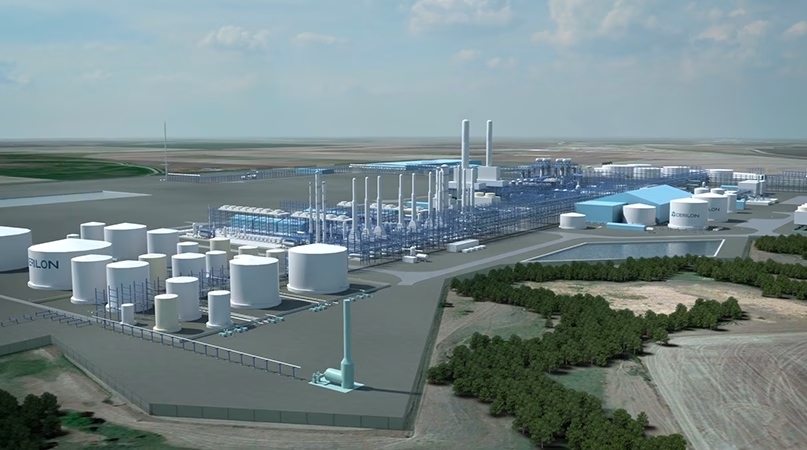
ND: Cerilon GTL North Dakota will be the first large-scale, natural gas-fed GTL facility to be built in North America.
It will also include CCS, making this nominally 25,000 barrel-per-day facility the first of its kind in the world.
The innovative facility will transform natural gas into unique, high-performance synthetic products, including industry-leading Group III+ base oils, ultra-low sulfur diesel, and naphtha.
GTL facilities incorporate proven processes and technologies to achieve this conversion. The first step of the GTL process is syngas generation, converting natural gas into synthesis gas.
The second step, the Fischer-Tropsch process, involves a series of reactions to convert the synthesis gas into a waxy feedstock.
Finally, a suite of technologies is applied to upgrade this waxy feedstock into high-quality final products.
This project will also generate excess power to be sold into the local electrical grid or data center application.
With GTL North Dakota set to make Cerilon the first significant producer of high-quality Group III+ base oils in North America, can you explain how use of these oils can increase energy efficiency and GHG savings?
ND: Cerilon engaged a third-party specialist to conduct a lifecycle assessment (LCA) of GHG from the GTL facility, comparing both manufacturing and product end-use benefits to a suitable conventional refinery baseline.
Cerilon’s LCA findings clearly demonstrate significant end-use GHG savings achieved from the use of Group III+ base oils in a variety of applications.
Significant lifecycle GHG savings are achieved in the end use of lubricants containing high-quality GTL Group III+ base oils when compared to conventional refinery alternatives due to the ultra-high viscosity index and oxidative stability of these lubricants.
These qualities allow the blending of engine oils that create engine efficiency improvements in existing applications without sacrificing other necessary lubrication properties.
As an example, in ‘drop-in’ engine applications, these lubricants create a leveraging effect where a small amount of high-quality base oil creates fuel efficiency savings over the service interval of a vehicle.
This Group III+ end-use benefit, paired with CCS at the facility and additional GHG reductions from the use of high-quality GTL diesel and naphtha, results in a calculated GHG performance of the Cerilon facility that is significantly below the conventional refinery ‘business-as-usual’ baseline case.
In addition to the direct capture and sequestration of over 450,000 tons per annum (tpa) of carbon dioxide at the GTL facility, Cerilon estimates that the use of lubricants containing high-quality GTL Group III+ base oils results in GHG savings in excess of 900,000 tpa when compared to conventional refinery Group III based products.
These GHG emission reductions are estimated to be more than the manufacturing footprint of the GTL facility itself and the equivalent of removing 200,000 cars from the road.
“GTL products contain negligible amounts of aromatics, polycyclic aromatics, sulfur, and nitrogen. These qualities, superior to conventional analogues, offer air quality benefits, low toxicity, and a level of stability that is particularly advantageous in confined applications, sensitive aquatic environments, or where long-term storage is required”
Nico Duursema, CEO, Cerilon
Can you tell us more about your partnership with ABB, who will provide Main Automation Control (MAC) design services to support the entire lifecycle of GTL North Dakota? What are the key benefits of collaborations such as these?
ND: We are bringing together a number of key partners with global expertise in engineering, technology, and automation.
Each of these partners will participate in the design of the facility and provide start-up and operational support.
The key benefit of partnering with best-in-class organizations with significant experience and proven technologies is that you can weave that experience together to produce state-of-the-art solutions.
ABB is acting as our main automation contractor to provide automation expertise and equipment. They will be providing their distributed control system (DCS) and operational systems for the facility.
ABB’s open structure allows for plug-and-play capabilities, and we will be overlaying our Cerilon Value Optimizer (CVO™) to improve decision making and optimize the facility using ML and agentic AI on the digital twin of the facility.
This will be a smart manufacturing facility with an associated data center offering excess capacity to other users.

What does corporate social responsibility mean to Cerilon, and how do you support the communities in which you operate?
ND: Cerilon is committed to operating safely and responsibly. This includes effectively addressing the potential impacts of our business on people and the environment, while preserving our ability to create value.
Our four corporate pillars – ownership, leadership, stewardship, and excellence – guide corporate decisions and behaviors.
The stewardship pillar requires that relationships and assets be managed in ways that lead to sustainable benefits for stakeholders, the economy, and the environment. Cerilon believes that this approach to decision-making supports the long-term economic sustainability of our business.
Our corporate environmental, social, and governance (ESG) strategy emphasizes and integrates environmental and social responsibility into all aspects of our business.
We manage relationships with our workforce, partners, customers, suppliers, and communities to understand the impacts on people across the value chain.
In relation to our project in North Dakota, we launched a broad stakeholder engagement program in 2022 that has been recognized by government officials and regulators as exceeding their expectations for community engagement.
In addition to the economic and employment benefits we will bring, this early engagement allows us to learn where we can make the most positive, measurable impacts, and we will look to invest in programs and infrastructure that matter most to the local community.
Having recently participated in the Canadian Energy Executive Association’s 74th Energy Business Forum, how can Cerilon relate to the forum’s ‘Wild Frontier’ theme, which celebrates the boldness and adaptability required in today’s energy landscape?
ND: The Wild Frontier theme describes our disruptive, volatile, uncertain, complex, and ambiguous (DVUCA) world where you can thrive with the right mindset, approach, and toolsets.
Cerilon is an intelligent, adaptive, and learning organization that is fully integrated to deliver results supported by AI and global partnerships.
DVUCA environments require pioneering innovation backed by proven fundamentals and people with a solution-oriented mindset and can-do attitude. This is the culture we are building at Cerilon.
Finally, what are the company’s key priorities for the future?
ND: Our key priority is to successfully deliver the first GTL facility in North Dakota, which will require excellence, passion, and perseverance from our team and partners.
We must have the grit to navigate through these rapid changes and uncertain times to stay the course and deliver results.
Fostering our partnerships and key stakeholders on this journey will be essential. Our partners were carefully and strategically selected to align with our vision and have the capabilities and intention to scale with us for the energy transition.
Our portfolio approach is to build one and replicate many, and we are reviewing multiple sites and locations where we can add value to natural gas resources.
We will use our digital capabilities to reduce the time to market for several facilities in the portfolio. These digital tools will also be offered to other proponents with existing or greenfield projects through our CerilonSoft subsidiary.