



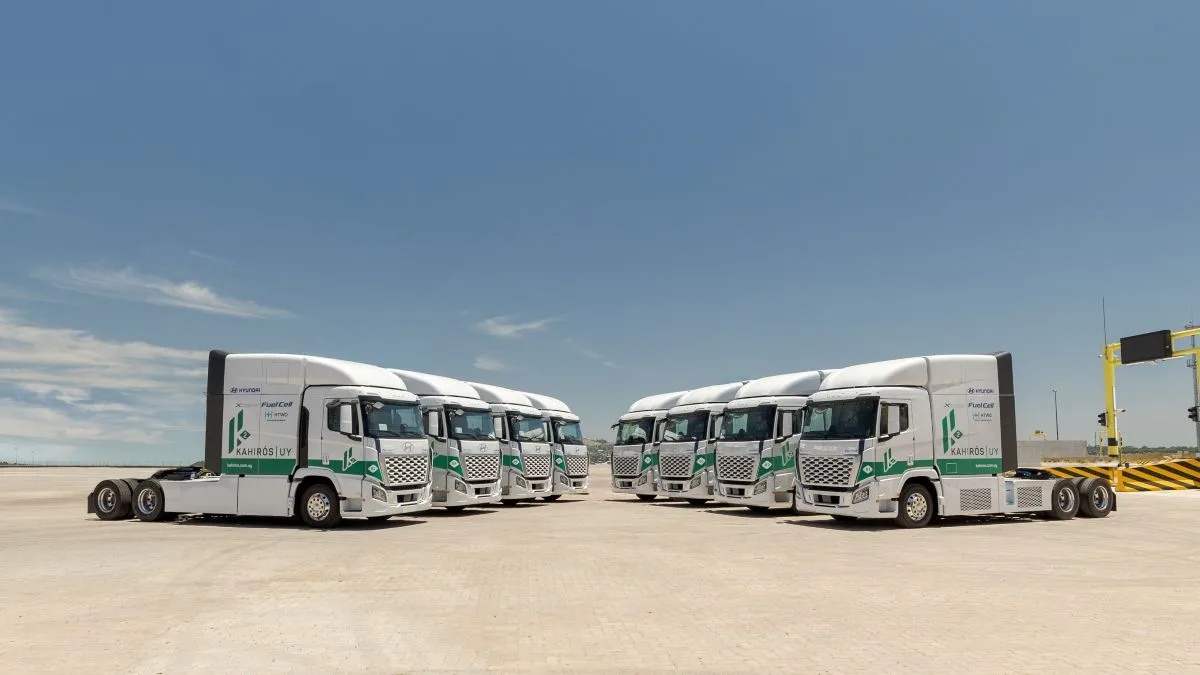
Hyundai Motor Company has announced the deployment of the first XCIENT Fuel Cell Class-8 heavy-duty truck fleet in South America, intending to advance low-carbon freight solutions.
BRINGING HYDROGEN FUEL CELL TRUCKS TO NORTH AMERICA
Reinforcing its leadership in zero tailpipe emissions vehicles, Hyundai Motor Company (Hyundai) is set to launch XCIENT Fuel Cell Class 8 heavy-duty truck fleet of eight vehicles in Uruguay, marking South America’s first fleet operation of hydrogen fuel cell electric heavy-duty trucks.
Hyundai’s deployment of the XCIENT Fuel Cell trucks supports the Kahirós Project, a local initiative aimed at decarbonising timber logistics through the development and use of green hydrogen infrastructure.
Key milestones of the operation in Uruguay include it being the first deployment of hydrogen-powered heavy-duty trucks for commercial operation, rather than demonstration, in South America.
Hyundai’s participation in the Kahirós Project, alongside Uruguayan consortium partners Fidocar, Fraylog, and Ventus, and backed by investment from Santander Group, demonstrates a commitment to reducing carbon emissions in local freight transport and accelerating zero tailpipe emissions logistics.
THE KAHIRÓS PROJECT
The Kahirós Project is designed to decarbonise timber logistics in Uruguay by using green hydrogen produced from renewable sources to power hydrogen fuel cell trucks.
The South American country has embraced renewable energy, generating 99 percent of its electricity from renewable sources in 2024, according to the country’s Ministry of Industry, Energy, and Mining.
Within this framework, the Kahirós Project aims to achieve decarbonisation in local operations, including the deployment of XCIENT Fuel Cell trucks over a 10-year period.
Kahirós Associates, the organisation behind the project, is a joint venture between Ventus (energy), Fraylog (logistics), and Fidocar, Hyundai’s local distributor. The initiative is supported by a USD$40 million investment from Santander Group, alongside backing from the International Finance Corporation of the World Bank and the United Nations’ Renewable Energy Innovation Fund.
As part of the project, a 4.8-megawatt solar facility will be developed, alongside an electrolysis plant capable of producing 77 tons of green hydrogen annually. Operations are expected to commence in November 2026.
Under normal operating conditions, the core fleet of six trucks is projected to cover close to one million kilometres (km) each year. Hyundai will also supply two additional tractor units to provide operational support and explore further expansion opportunities, bringing the total fleet to eight vehicles.
SUPPORTING SUSTAINABLE MOBILITY IN SOUTH AMERICA
Uruguay’s adoption of hydrogen-powered heavy-duty trucks for routine use represents a first for the region and lays the groundwork for broader hydrogen production and refuelling infrastructure.
This development establishes a new benchmark for sustainable logistics across Central and South America and highlights Hyundai’s focus on practical decarbonisation solutions.
To ensure efficient implementation, Hyundai and Fidocar have deployed a dedicated aftersales team to train Kahirós personnel in maintenance and operational best practices.
“From the Kahirós team, we value the opportunity to contribute to the decarbonisation of freight transport in Uruguay, and we are committed to ensuring that this project becomes a pilot that sets the course for more actions at both the national and global levels, contributing to the efforts to position our country as a hub in this field,” comments Juan Andrés Chick, Kahirós Project Director.
“At Hyundai, we are committed to creating sustainable transportation solutions. Our Hyundai XCIENT trucks with hydrogen fuel cells supporting the Kahirós Project produce no tailpipe emissions and offer a lower-carbon alternative to traditional freight logistics methods.
“We will help decarbonise a critical part of the paper production value chain and demonstrate to the world that we can take action for a better future starting now,” adds Airton Cousseau, President & CEO of Hyundai Motor Brazil and Hyundai Motor Central and South America Region.
“It is meaningful that Hyundai expands its global leadership in clean mobility towards South America with its advanced hydrogen fuel cell technology in addition to its proven applications in North America and Europe.
At Hyundai, we aim to contribute to building a sustainable and safe freight ecosystem through hydrogen-powered commercial vehicles. Our partnership with Kahirós Associates has strengthened our devotion to innovation and commitment to sustainability as we share a vision for the future,” comments Chul Youn Park, Senior Vice President and Head of Global Commercial Vehicle and Light Commercial Vehicle Business Division at Hyundai.
KEY FEATURES OF THE XCIENT FUEL CELL TRUCK
- Hydrogen fuel cell system – Delivers a combined output of 180 kilowatts (kW) via two 90 kW fuel cell stacks.
- Performance – Equipped with a 350 kW (469 horse power) electric motor generating 2,237 newton-metre of torque for demanding freight applications.
- Energy capacity – Features 10 hydrogen tanks with a total capacity of 68 kilogrammes, supported by a 72 kW per hour battery.
- Driving range – Capable of travelling up to 450 miles (approximately 720 km) under optimal conditions.
- Heavy-duty specification – Class 8 tractor configuration with a gross combined weight of up to 82,000 lbs.
Collectively, these capabilities support long-distance transport with zero tailpipe emissions.
HYUNDAI’S BROADER HYDROGEN STRATEGY
Hyundai continues to scale its global hydrogen ecosystem through deployments in key markets, with Uruguay now joining established operations in North America and Europe.
Key milestones include:
- North America – 63 XCIENT Fuel Cell trucks have collectively exceeded approximately 1.6 million km since entering service in 2023.
- Europe – 165 trucks operating across Switzerland, Germany, France, the Netherlands, and Austria have surpassed 20 million km since their introduction in 2020.
Through these initiatives, Hyundai is demonstrating the viability of hydrogen-powered transport across multiple applications.
Supporting this approach, Hyundai Motor Group’s hydrogen platform, HTWO, provides end-to-end solutions across the value chain, fostering collaboration, investment, and innovation.