



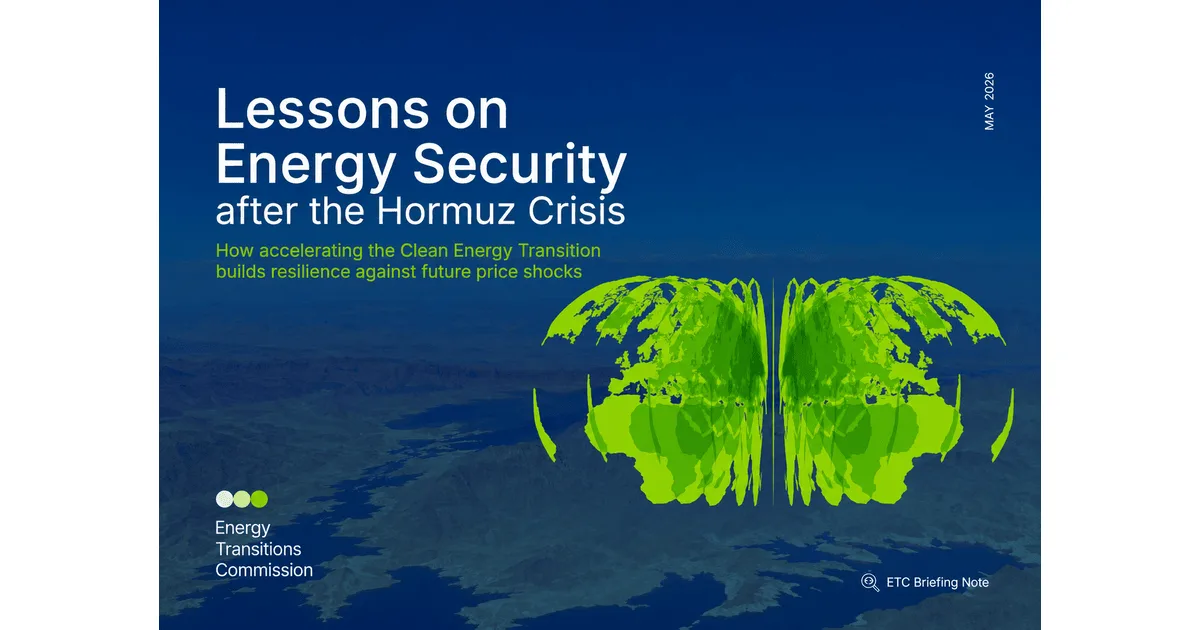
The Energy Transitions Commission says the Hormuz disruption underscores how fossil fuel dependence amplifies economic shocks, arguing that rapid deployment of clean energy could displace oil and gas exposure and strengthen long-term energy security and affordability.
- Energy security shock exposes fossil fuel system vulnerability
- Fossil fuel systems amplify shocks, clean energy absorbs them
- Clean energy deployment can displace Hormuz-linked fossil fuel flows
- Scale of the Hormuz disruption and economic impact
- Clean energy systems deliver lower and more stable energy costs
- Governments urged to accelerate clean energy transition
- Five priority actions to reduce fossil fuel exposure
- Market signals show rapid clean energy acceleration
- What is the Energy Transitions Commission?
Energy security shock exposes fossil fuel system vulnerability
The Energy Transitions Commission (ETC) has warned that crisis-driven responses to the recent Hormuz disruption risk locking economies into higher long-term costs and structural vulnerability if they reinforce fossil fuel dependence.
Instead, the organisation argues that accelerating clean energy deployment offers the most durable route to energy security, with renewable power, electrification and efficiency capable of displacing the equivalent of all oil flows through the Strait of Hormuz over the coming years.
The ETC says fossil fuel systems transmit shocks through global price mechanisms, while clean energy systems are structurally more resilient due to their capital-intensive, non-commodity cost base.
Fossil fuel systems amplify shocks, clean energy absorbs them
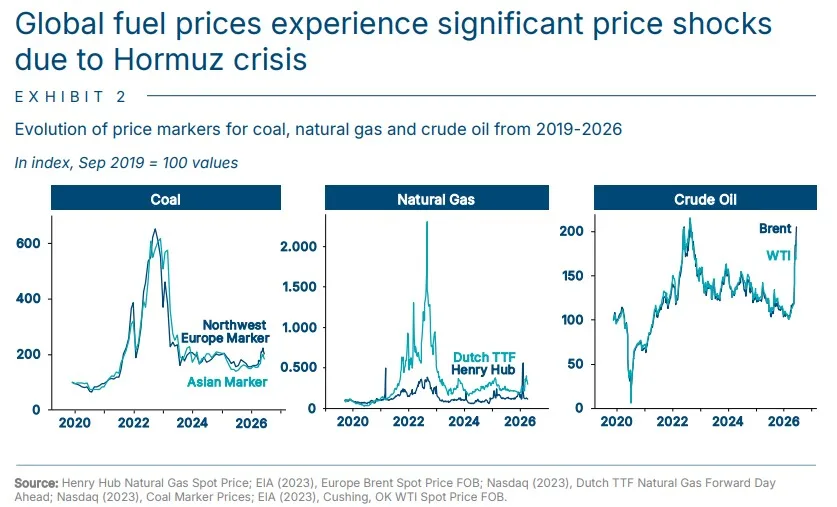
According to the report ‘Lessons on Energy Security after the Hormuz Crisis,’ fossil fuel energy systems rely on continuous commodity flows through concentrated geopolitical chokepoints, meaning disruptions are rapidly transmitted into global prices.
By contrast, 70–90% of clean energy costs are upfront capital investment. Once deployed, technologies such as solar, wind, batteries and grids provide stable energy output over long periods, largely insulated from market volatility.
The ETC estimates that sustained elevated fossil fuel prices could add $1–2 trillion in annual global oil and gas expenditure, comparable to the $1.5 trillion annual clean energy investment gap identified on the path to net zero.
Clean energy deployment can displace Hormuz-linked fossil fuel flows
The report highlights that new fossil fuel infrastructure risks locking in future exposure to similar shocks, noting that oil and gas fields often take 5–10 years to come online.
By contrast, technologies such as rooftop solar and heat pumps can scale within months, while electric vehicle adoption is already structurally reducing oil demand.
The ETC estimates EV deployment alone could displace around 5 million barrels per day by 2030 and 9–10 million barrels per day by 2035 — around half of pre-crisis Hormuz oil flows.
A coordinated clean energy response could reduce global oil demand by around 20% and gas demand by more than 30% by 2035, significantly lowering exposure to future supply disruptions.
Scale of the Hormuz disruption and economic impact
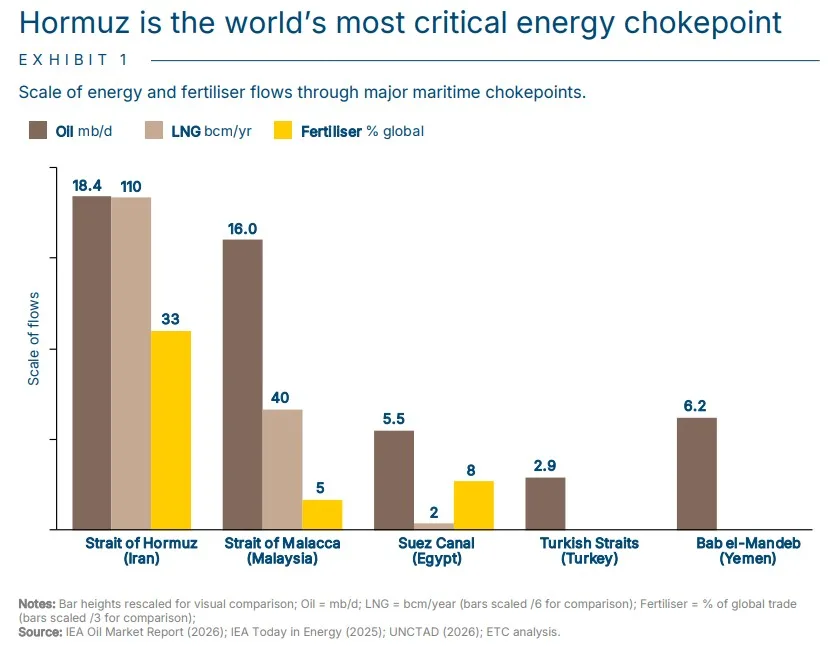
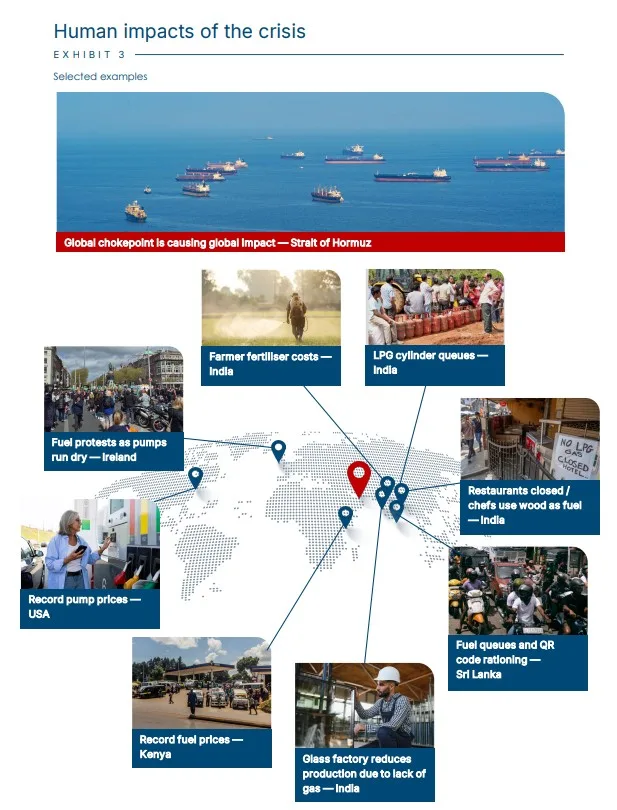
The report describes the Hormuz closure as the largest oil supply shock on record, disrupting 18.4 million barrels per day of oil, alongside around 20% of global LNG trade and one-third of globally traded fertilisers.
The effects are most severe in emerging and import-dependent economies, with approximately 84% of crude oil and more than 80% of LNG transiting Hormuz destined for Asian markets.
Oil prices rose from around $70 per barrel to as high as $90–120, while LNG prices increased from $10–12 per MMBtu to above $25. The ETC estimates the disruption could add $1–2 trillion in additional global fuel expenditure in 2026 if elevated prices persist.
Europe is estimated to be losing almost €500 million per day due to the shock.
Clean energy systems deliver lower and more stable energy costs
The ETC highlights differences in national exposure depending on energy system design.
Spain, with 57% renewable electricity, recorded the lowest energy price increases in the EU following the disruption, with prices around $50/MWh. By contrast, Singapore, heavily reliant on gas for power generation, saw prices above $200/MWh.
The Commission argues this divergence reflects system structure rather than geography, with renewable-heavy systems better able to absorb fossil fuel price volatility.
Governments urged to accelerate clean energy transition
The ETC calls for a coordinated policy response across renewables, electrification, green fuels, fertilisers and efficiency, arguing that such measures could displace oil and gas demand linked to the Strait of Hormuz by 2035.
Adair Turner, Co-Chair of the Energy Transitions Commission, said:
“The current crisis shows that fossil fuel dependence is not only a climate risk but also an economic and strategic vulnerability. Clean energy systems are more distributed, more efficient and less exposed to the price shocks created by continuous dependence on traded fuels.”
Jules Kortenhorst, Co-Chair of the Energy Transitions Commission, said:
“For decades we have built an energy system that is wasteful, insecure, and volatile. Three quarters of the world’s population depend on fuels they do not control, priced in markets they do not influence, vulnerable to shocks they cannot prevent. The defining question now is whether governments act to build a more resilient system or to sustain one which is already vulnerable to disruption.”
Five priority actions to reduce fossil fuel exposure
The ETC identifies five policy priorities to reduce volatility exposure while improving affordability and energy security:
- Accelerate renewable electricity deployment to displace gas in power systems, supported by storage, grids and flexibility
- Electrify road transport, with EVs potentially cutting global oil import spending by more than $600 billion annually
- Electrify heating and cooking, reducing reliance on gas and LPG while improving household affordability
- Scale green fuels and fertilisers, including cleaner fertiliser production and low-emissions fuels for hard-to-abate sectors
- Improve energy efficiency, including building retrofits, equipment standards and industrial optimisation
The report notes that short-term trade-offs may be required, including targeted household support and limited temporary use of existing coal or LNG infrastructure in some markets. However, it cautions against new fossil fuel lock-in measures such as expanded coal capacity, long-lived LNG infrastructure expansion, or weakened carbon pricing signals.
Market signals show rapid clean energy acceleration
Despite market volatility, the ETC highlights accelerating deployment of clean technologies.
Chinese solar exports doubled month-on-month in March. Around 50 countries recorded record solar PV imports, including India (up ~140%) and Ethiopia (up ~390% year-on-year). EU electric vehicle registrations rose nearly 50% year-on-year, while India saw a surge in induction cooktop sales as LPG shortages drove fuel switching.
What is the Energy Transitions Commission?
The Energy Transitions Commission is a global coalition of leaders from across the energy sector focused on achieving net-zero emissions by mid-century in line with the Paris Agreement goal of limiting global warming to well below 2°C.
The organisation is hosted by SYSTEMIQ Ltd.
This article was produced by the editorial team at Sustainability Outlook and published as part of the Outlook Publishing global network of B2B industry magazines.
Outlook Publishing delivers industry insights, company stories, and sector coverage across sustainability, energy transition, manufacturing, mining, construction, supply chains, healthcare, and food production.
Sustainability Outlook provides ongoing coverage of organisations and developments shaping the global sustainability landscape.