



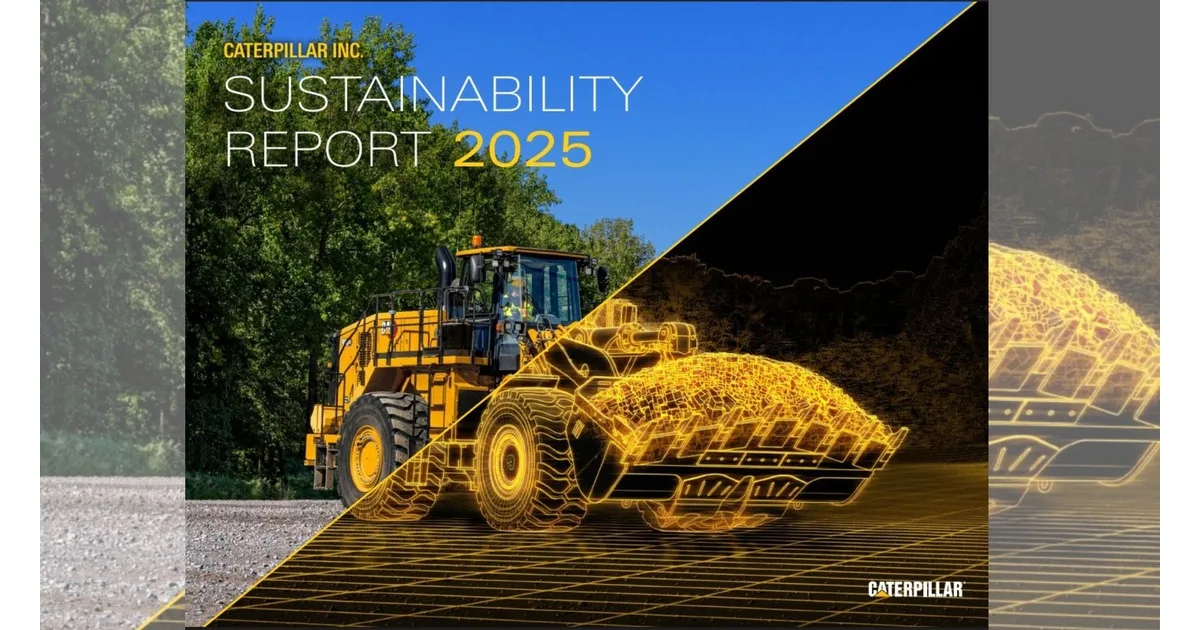
Caterpillar’s 2025 Sustainability Report outlines how the mining and heavy equipment manufacturer is expanding remanufacturing, electrification, alternative fuel technologies and safety systems as customers face increasing pressure to improve operational efficiency and reduce emissions.
- Caterpillar positions sustainability around mining and industrial customer needs
- Circular economy strategy expands through Cat Reman and rebuild programmes
- Electrification and alternative fuels support mining decarbonisation
- Safety technologies expand across mining and heavy equipment operations
- Operational emissions and energy efficiency progress
- Scope 3 emissions remain largest sustainability challenge
- Workforce development and mining skills investment
Caterpillar positions sustainability around mining and industrial customer needs
Caterpillar says growing global demand for infrastructure, energy and critical minerals is increasing pressure on mining and industrial operators to improve efficiency, reduce emissions and extend asset life.
In its 2025 Sustainability Report, the company outlined progress across remanufacturing, lower-emissions technologies, operational efficiency and workforce safety, while reaffirming its long-term sustainability and growth strategy.

“The world’s demand for infrastructure, energy and critical minerals is accelerating, and our customers are at the center of meeting it,” said Joseph E. Creed, Chairman and CEO of Caterpillar.
“That is a tremendous opportunity for Caterpillar, but it is also a tremendous responsibility. The work our customers do must be done safely, efficiently and sustainably. Our job is to make sure they can.”
“At Caterpillar, our mission is solving our customers’ toughest challenges. Our purpose is building a better, more sustainable world. Those are not separate ideas—they reinforce each other.”
Circular economy strategy expands through Cat Reman and rebuild programmes
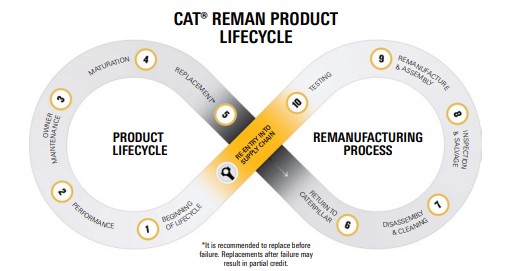
The report places significant emphasis on Caterpillar’s circular economy strategy, particularly through Cat Reman and machine rebuild programmes designed to extend equipment life and reduce material use.
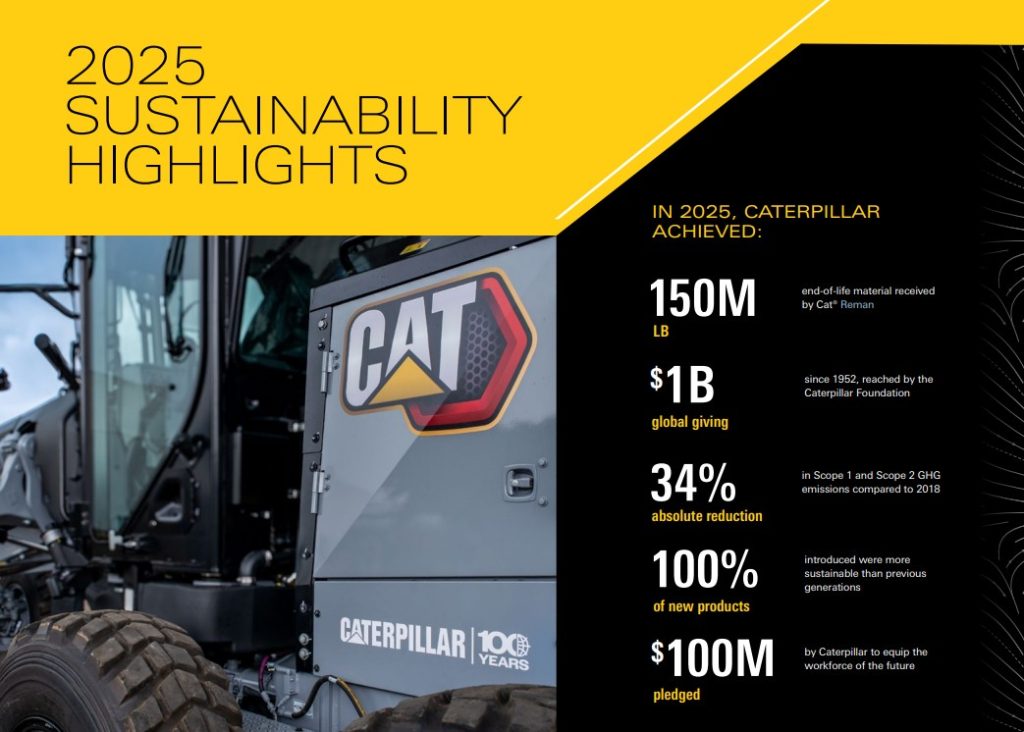
Caterpillar said Cat Reman now includes more than 8,000 offerings across multiple industries, with engineers increasingly integrating remanufacturing considerations into product development and the company reported receiving 150 million pounds of end-of-life material through Cat Reman operations during 2025.
A featured example highlighted the rebuild of Cat 336 excavators using remanufactured engines and hydraulic systems alongside rebuilt or replacement components to restore machines to peak operating performance.
A Cat Certified Rebuild can reduce customer Scope 3 greenhouse gas emissions by a minimum of 70% compared with purchasing an equivalent new machine.
Electrification and alternative fuels support mining decarbonisation
Caterpillar continues investing in a broad portfolio of lower-emissions technologies, including diesel-electric, battery-electric, hybrid and alternative fuel systems.
The company said sustainability progress must remain practical and adaptable to customer operating conditions across industries and regions.
“We know every customer is different, so our starting point is always a discussion to understand what success looks like to them. Their goals may be to use less fuel, extend machine life, lower maintenance and operating costs or reduce emissions, among others,” said Caterpillar’s Chief Sustainability and Strategy Officer Ebban Clause.
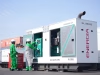
“That solution might be leveraging a hybrid diesel-electric machine or battery electric machine, rebuilding their existing fleet or using alternative fuels such as biodiesel, renewable diesel (HVO) or hydrogen blends in their genset, to name a few examples.”
The report also highlighted increasing use of connected technologies such as the VisionLink platform to improve fleet visibility, fuel management and operational decision-making.

Safety technologies expand across mining and heavy equipment operations
Safety remained a major focus throughout the report, particularly for mining and industrial applications involving high-energy operating environments.
Caterpillar said nearly 11,000 Driver Safety System-equipped machines and light vehicles were connected globally during 2025.
The company also expanded direct safety control technologies, including motion inhibit systems, automatic emergency braking and Cat 2D E-fence technology designed to prevent machines from moving beyond predefined operating boundaries.
Other investments included AI-enabled camera systems and pedestrian detection technologies across several facilities and Caterpillar improved recordable injury frequency by 23% compared with its 2018 baseline and has achieved a 93% improvement in recordable injury frequency since 2003.
Operational emissions and energy efficiency progress
Caterpillar reported a 34% reduction in Scope 1 and Scope 2 greenhouse gas emissions from its operations compared with its 2018 baseline, exceeding its 2030 target pathway of a 30% reduction.
The company also reported a 25% reduction in energy intensity since 2021.
Key Projects
- Hybrid microgrid deployment at Caterpillar’s Tucson Proving Ground in Arizona
- Solar installations at the Queensland distribution centre in Australia
- Water reduction projects at the Grenoble, France facility
- Solvent reclamation programmes in Decatur, Illinois
Scope 3 emissions remain largest sustainability challenge
Caterpillar stated that Scope 3 Category 11 emissions from the use of sold products remain the company’s largest emissions category, representing more than 95% of total Scope 1, 2 and 3 emissions.
The company said emissions increased during 2025 due to product mix, end-market demand and continued growth in global energy demand.
However, Caterpillar repeated its commitment that 100% of new products introduced through 2030 will be more sustainable than previous generations through improved efficiency, lower emissions, reduced waste and enhanced rebuild and remanufacturing capability.
Workforce development and mining skills investment
The report also outlined workforce and skills initiatives linked to the future of industrial and mining operations.
Caterpillar announced a US$100 million commitment over five years to support workforce development and manufacturing skills training and also reported employing more than 118,000 people globally during 2025, including more than 64,500 manufacturing employees.
More than 1.2 million training courses were completed by employees during the year, while over 1,900 interns joined the business globally.
“Sustainability is core to how we execute the strategy, serve our customers and build a company that will be essential for the next 100 years, just as it has been for the first,” added Joseph E. Creed.
This article was produced by the editorial team at Sustainability Outlook and published as part of the Outlook Publishing global network of B2B industry magazines.
Outlook Publishing delivers industry insights, company stories, and sector coverage across sustainability, energy transition, manufacturing, mining, construction, supply chains, healthcare, and food production.
Sustainability Outlook provides ongoing coverage of organisations and developments shaping the global sustainability landscape.