Neil Perry is Content Director for Outlook Publishing.
- Content Director
Share
Mastercard is scaling its digital infrastructure while working to reduce emissions, positioning sustainable technology as a core lever for long-term business performance.
The company’s latest update outlines how carbon-aware software engineering, hardware optimization, and data-driven decision-making are reshaping its global technology stack.
Mastercard reported strong progress against its interim climate targets in 2025, cutting Scope 1 and 2 emissions by 44% and Scope 3 emissions by 46% from 2016 levels.
This came alongside continued commercial growth, with net revenue rising 16% while overall emissions declined by 1% year over year — marking a third consecutive year of emissions reduction and signaling early evidence that growth can be decoupled from environmental impact.
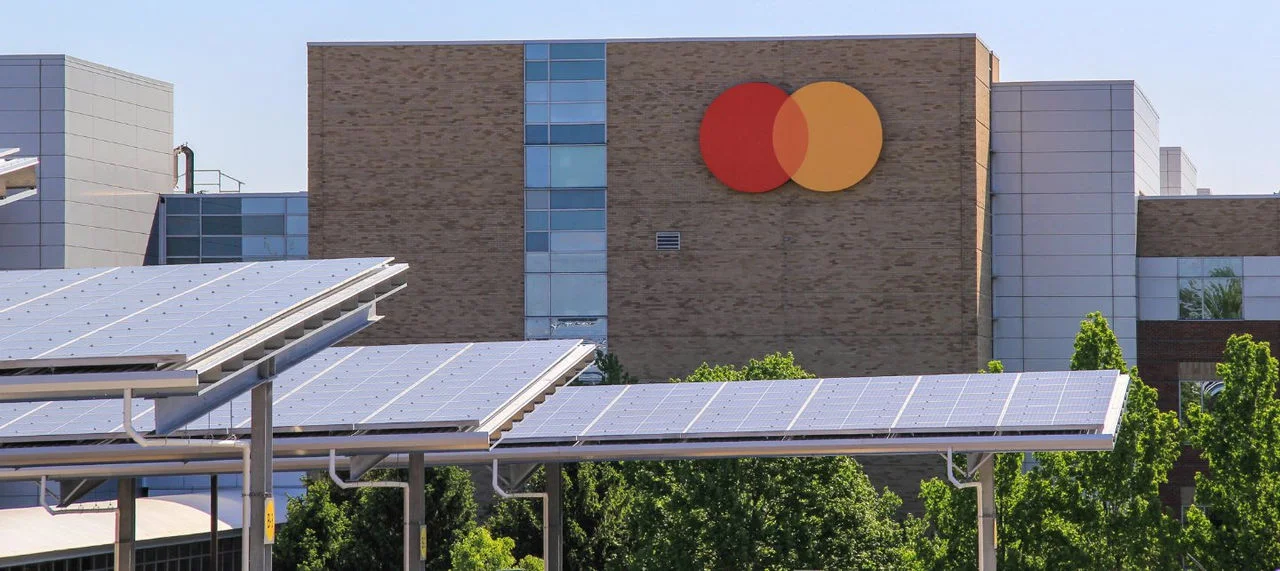
Renewable energy at Mastercard’s facilities, such as solar panels at the St. Louis Tech Hub, advance the company’s environmental goals and increase resilience, including for neighbors and the local grid. (Photo credit: Christopher Polley)
Sustainability Positioned as a Performance Driver
“This Earth Day, Mastercard is demonstrating that we can scale the digital economy, without scaling emissions,” said Ellen Jackowski, Chief Sustainability Officer at Mastercard, writing on LinkedIn on Earth Day.
“These results reinforce a simple but important point: with focus, discipline and support from across the company, environmental sustainability does not have to be a constraint on performance. It can be a catalyst for it.”
The company identified its technology footprint as central to its emissions profile. Data centers represent around 60% of Scope 1 and 2 emissions, while technology goods and services account for roughly one-third of Scope 3 emissions.
This has driven a strategy focused on improving efficiency across applications, hardware, and the energy systems that support them.
The lake outside Mastercard’s St. Louis Tech Hub serves as a back-up source of water for the company’s chillers, which cool the company’s data center. (Photo credit: Mira Belgrave)
Renewable Energy and Governance Underpin Strategy
Renewable energy remains a key driver of emissions reduction, supported by broader efforts spanning procurement, supply chain engagement, and embedding sustainability into day-to-day business decisions.
A dedicated Sustainable Technology Steering Committee oversees execution, ensuring accountability and alignment with company-wide objectives.
Data-Driven Sustainability Across the Tech Stack
Since 2023, Mastercard has built a patent-pending dashboard that assigns a Sustainability Score to each technology asset.
By integrating metrics such as real-time energy consumption, carbon intensity, server utilization, and system consolidation, the platform provides visibility into performance and enables targeted action across operations.
Embedding Carbon Awareness in Software Engineering
Sustainability is now integrated into how Mastercard designs and deploys applications.
Through its engineering community, the company has adopted principles from the Green Software Foundation, focusing on efficient design, runtime optimization, and carbon-aware decision-making. These practices are embedded into engineering standards and review processes, ensuring environmental impact is considered before deployment.
On the infrastructure side, Mastercard is improving efficiency by consolidating and decommissioning underutilized hardware.
More than 3,700 devices have been removed since 2024, with the pace of decommissioning increasing significantly into 2026. The company is also expanding the use of dynamic power settings to adjust energy consumption in real time based on workload demands.
Optimizing Cloud and Data Center Operations
Mastercard operates across owned, co-located, and cloud environments, requiring close collaboration with suppliers to manage emissions.
Efforts include improving visibility into energy and emissions data and standardizing reporting, including work with Greenpixie. This enables more precise workload placement based on carbon intensity and energy availability.
Net Zero Ambition Backed by Technology Innovation
The company’s approach links emissions reduction directly to its broader mission of powering the digital economy.
“Today, we are celebrating our progress while remaining focused on the work ahead as we continue our journey to reach net zero emissions by 2040,” added Ellen Jackowski.
Mastercard’s strategy demonstrates how aligning technology innovation with sustainability goals can enable both environmental progress and business growth at scale.
This article was produced by the editorial team at Sustainability Outlook and published as part of the Outlook Publishing global network of B2B industry magazines.
Outlook Publishing delivers industry insights, company stories, and sector coverage across sustainability, energy transition, manufacturing, mining, construction, supply chains, healthcare, and food production.
Sustainability Outlook provides ongoing coverage of organisations and developments shaping the global sustainability landscape.