



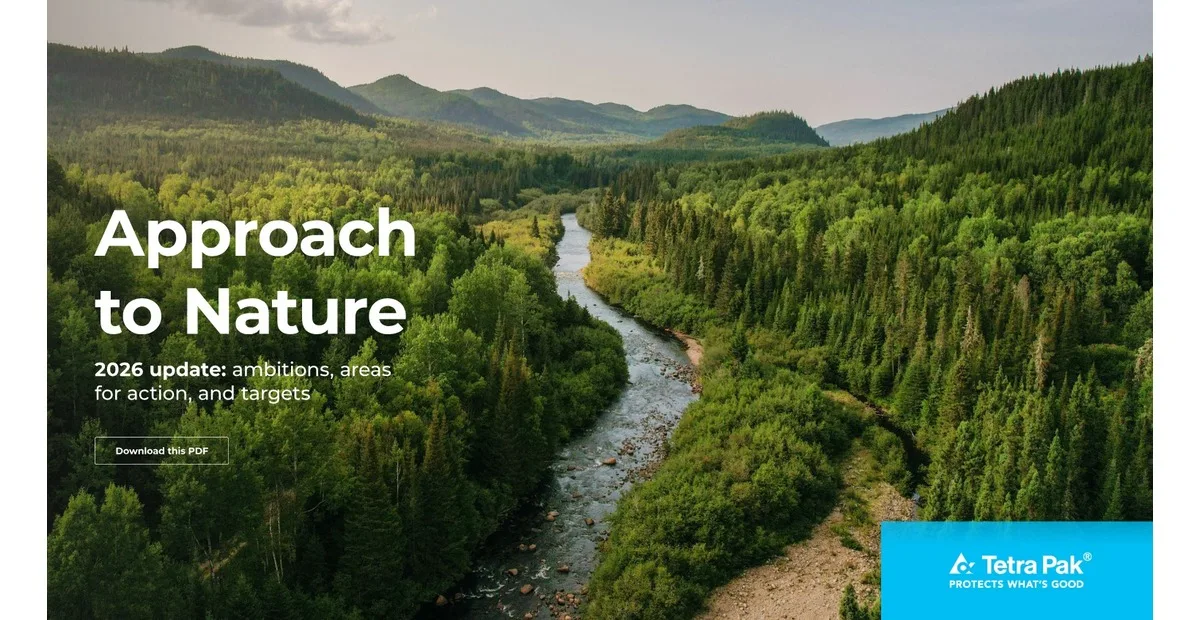
Tetra Pak has updated its Approach to Nature framework, sharpening its focus on responsible sourcing and water resilience as the company seeks to address its most significant nature-related impacts and dependencies.
- Refreshed Framework Targets High-Impact Areas Across the Value Chain
- Greater Focus on Responsible Sourcing
- Water Resilience Moves Higher on the Agenda
- Circular Economy Remains a Core Priority
- Industry Recognition for Adaptive Sustainability Strategy
- Progress Report Highlights Supply Chain and Environmental Gains
Refreshed Framework Targets High-Impact Areas Across the Value Chain
The revised framework follows two years of implementation and is designed to direct resources towards the areas where the company believes it can deliver the greatest positive impact across its value chain.
Originally launched in 2024, the Approach to Nature established more than 20 targets aimed at helping halt and reverse nature loss, restore ecosystems and enhance global water security in alignment with international biodiversity goals.
According to Tetra Pak, the refreshed framework introduces a more targeted approach focused on high-impact materials, locations and supplier sites, while strengthening expectations around traceability, verification and measurable outcomes.
Greater Focus on Responsible Sourcing
A key element of the update is an increased emphasis on upstream activities, where Tetra Pak says its most significant nature impacts and dependencies occur.
The framework continues to be structured around four action areas—Upstream, Operations, Downstream and Transform—but now prioritises interventions within sourcing and supplier engagement programmes.
Among the revised goals is the use of geographic information systems to verify the deforestation-free status of high-priority sourcing locations.
The updated approach reflects lessons learned during implementation and is intended to improve the effectiveness of nature-related action across its supply chain.
Francesca Priora, Vice President Climate & Nature at Tetra Pak, said: “Two years of implementation have given us much clearer insight. The refresh of our Approach to Nature reflects a shift towards sharper execution, focusing action where it can deliver the greatest impact across the value chain.
“Our industry relies heavily on nature to shape sustainable and secure food systems for the future. As we move towards our next milestones, collaboration remains critical. By working closely with suppliers, customers and partners, we aim to protect key ecosystems and help strengthen the resilience of food systems”.

Water Resilience Moves Higher on the Agenda
The revised framework also strengthens Tetra Pak’s focus on water stewardship and resilience.
New targets include reducing total water withdrawal by 10% by 2030 at supplier sites identified as having the highest water-related impacts, and high-impact suppliers are already being required to report on both water quality and water quantity, supporting improved visibility of water-related risks across the value chain.
The enhanced focus reflects growing recognition of water security as a critical sustainability issue for both manufacturing operations and food systems.

Circular Economy Remains a Core Priority
Alongside biodiversity and water-related initiatives, the Approach to Nature continues to support Tetra Pak’s circular economy objectives.
The framework includes actions focused on improving product design and performance, increasing equipment efficiency, and strengthening collection, recycling and waste management systems.
These initiatives remain an important component of reducing environmental impacts across the packaging value chain.
Industry Recognition for Adaptive Sustainability Strategy
Alexander Nick, Senior Director Climate and Nature at WBCSD, welcomed the update and highlighted the importance of reviewing sustainability strategies as implementation progresses.
“Tetra Pak’s updated Approach to Nature reflects an effort to translate ambition into clearer priorities and action across its value chain. By recognizing interdependencies across sustainability areas and taking stock of implementation experience, the company is strengthening the focus of its approach over time. WBCSD welcomes this willingness to review and adapt: sharpening focus, learning from practice, and aligning corporate action with the shared global ambition to halt and reverse nature loss.”

Progress Report Highlights Supply Chain and Environmental Gains
Tetra Pak also outlined progress achieved since launching the framework in 2024.
The company said it has engaged its entire supplier base in nature-related impact assessments and established procurement requirements linked to nature performance.
In responsible sourcing, Tetra Pak reported sourcing 100% of the paper-based materials used in its products from FSC-certified and other controlled sources, while 100% of its plant-based polymers are sourced as Bonsucro-certified.
It also reported progress on water resilience initiatives and said it has already achieved its 2030 target to reduce volatile organic compound emissions across production sites by 50% against a 2019 baseline.
According to Tetra Pak, the latest framework update is intended to build on these results by concentrating future efforts on the areas where the company can deliver the greatest contribution to ecosystem protection, biodiversity recovery and resilient food systems.