



Oritain’s inaugural 2026 Global Supply Chain Intelligence Report argues that traceability alone is no longer sufficient as brands face growing regulatory scrutiny, consumer scepticism and increasing exposure to prohibited sourcing risks across global supply chains.
- Supply chain verification emerging as critical sustainability issue
- Key Insights from Oritain’s 2026 Global Supply Chain Intelligence Report
- Transparency initiatives failing to keep pace with risk exposure
- Regulatory pressure and sourcing shifts driving renewed exposure
- Consumer trust increasingly tied to scientific verification
- Financial and operational impacts becoming more immediate
- Shift from traceability to verification
- Scientific verification becoming central to supply chain resilience
Supply chain verification emerging as critical sustainability issue
Oritain has launched its first Global Supply Chain Intelligence Report, warning that economic pressure, tightening enforcement and shifting sourcing patterns are exposing weaknesses in existing supply chain assurance systems.
The forensic origin verification specialist said the findings point to a widening “verification gap” between documented traceability and independently verified sourcing practices, with growing implications for compliance, consumer trust and market access.
Using cotton as a case study commodity, the report found that exposure to cotton prohibited under legislation has returned to pre-2021 levels after several years of improvement.
Key Insights from Oritain’s 2026 Global Supply Chain Intelligence Report
- Risk Re-emergence: As sourcing patterns shift under tariff, trade and policy pressure, global manufacturing capacity is expanding faster than internal controls and traditional compliance models can adapt.
- Systemic Exposure: With 90% of brands analysed impacted by exposure to prohibited cotton, exposure is no longer an isolated issue. It reflects a system wide challenge requiring a programmatic, scientific approach rather than ad hoc checks or reliance purely on paper trails
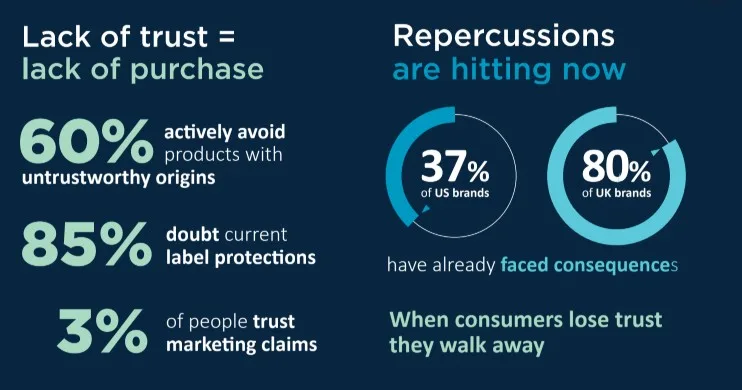
- The Trust Deficit: Consumer scepticism is at record levels. 60% of consumers actively avoid products linked to untrustworthy origins, while only 3% trust marketing claims. Instead, trust is anchored in credible, independent evidence, with government regulation (27%) and scientific traceability to origin (23%) sitting at the top of the hierarchy of consumer trust.
- Transparency expectations are rising across materials: focusing on leather alone, 69% of consumers support mandatory ethical sourcing proof, reinforcing the need for the inclusion of leather within the EUDR scope.
- The Cost of Failure: The consequences are no longer theoretical. 80% of UK brands and 37% of US brands surveyed have already experienced material impact, including border delays, financial penalties, disrupted production cycles and lost commercial relationships.
Transparency initiatives failing to keep pace with risk exposure
The report draws on forensic sampling of approximately 1,000 garments annually across 40 brands, alongside consumer, supplier and industry intelligence data covering major manufacturing hubs.
While 94% of UK companies and 87% of US companies surveyed reported tracing their cotton supply chains, Oritain’s analysis found that 90% of brands assessed in 2025 recorded at least one “risk consistent” result linked to prohibited cotton exposure, up from 64% the previous year.
According to the report, the findings suggest that transparency initiatives have expanded faster than effective assurance systems.
Regulatory pressure and sourcing shifts driving renewed exposure
Oritain said global sourcing patterns are being reshaped by tariffs, trade policy and geopolitical pressures, with manufacturing capacity expanding more rapidly than traditional compliance controls can adapt.
The company argues that periodic assurance models are becoming increasingly ineffective as supply chains grow more fragmented and complex.
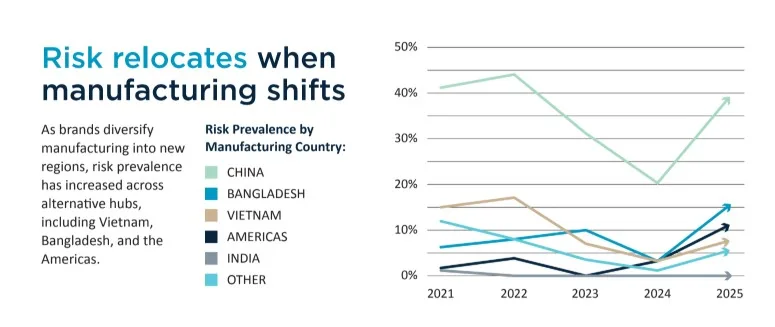
“The data tells a clear story: risk isn’t disappearing, it is re-emerging,” said Alyn Franklin, CEO of Oritain.
“As brands pivot manufacturing regions they’re finding that upstream material exposure hasn’t gone away – it is increasingly appearing in other key manufacturing hubs. Without independent verification, that risk travels quietly through complex trade routes and only surfaces at the end of the supply chain, when goods are stopped, costs escalate and production timelines are already missed.”
Consumer trust increasingly tied to scientific verification
The report also highlights growing consumer scepticism toward sustainability and sourcing claims.
According to Oritain’s findings, 60% of consumers actively avoid products linked to untrustworthy origins, while only 3% trust brand marketing claims related to sourcing and sustainability.
Instead, consumer confidence is increasingly linked to external validation, with government regulation and scientific traceability identified as the most trusted forms of assurance.
The report found that 69% of consumers support mandatory ethical sourcing proof for leather products, reinforcing calls for broader inclusion of leather within the EU Deforestation Regulation (EUDR) framework.
Financial and operational impacts becoming more immediate
The report argues that supply chain failures are now creating direct commercial consequences rather than reputational concerns alone.
According to the findings, 80% of UK brands and 37% of US brands surveyed reported experiencing material impacts linked to sourcing risk exposure, including border delays, financial penalties, disrupted production schedules and damaged commercial relationships.
Oritain said these pressures are increasing demand for continuous, evidence-based supply chain verification models.
Shift from traceability to verification
A central theme of the report is the distinction between traceability and verification.
Oritain argues that while traceability demonstrates process and intent, independent forensic verification provides what it describes as a “defensible source of truth” in an increasingly enforcement-led regulatory environment.
The company advocates for a programmatic verification model combining forensic science, data analysis and continuous monitoring across brands, suppliers and regulators.
“As regulatory and economic pressures intensify, visibility without verification no longer holds,” adds Franklin.
“What matters now is evidence that stands up. Oritain’s role is to provide the science, intelligence and networked approach that allows organisations to move from reactive compliance to proactive supply chain management – building trust that is measurable, defensible and scalable over time.”

Scientific verification becoming central to supply chain resilience
Oritain said resilient supply chains will increasingly depend on continuous and independently validated sourcing intelligence rather than reliance on declarations and paper-based systems alone.
The company’s verification methodology combines isotopes, trace elements, non-traditional isotopes and statistical modelling with a global reference database to validate product origin across sectors including cotton, leather, timber, coffee, meat and dairy.
The approach is designed to support regulatory compliance, reduce reputational risk and strengthen confidence in sustainability and sourcing claims across global supply chains.
This article was produced by the editorial team at Sustainability Outlook and published as part of the Outlook Publishing global network of B2B industry magazines.
Outlook Publishing delivers industry insights, company stories, and sector coverage across sustainability, energy transition, manufacturing, mining, construction, supply chains, healthcare, and food production.
Sustainability Outlook provides ongoing coverage of organisations and developments shaping the global sustainability landscape.