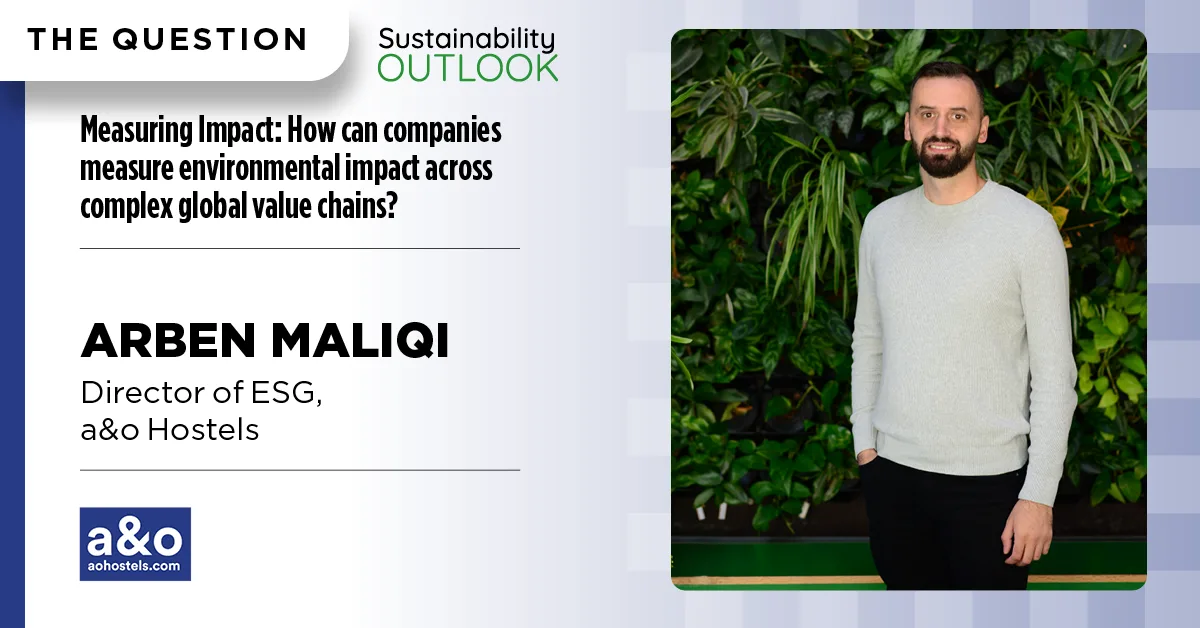





Companies measure environmental impact across complex global value chains by treating measurement as a management system, not an annual calculation. The first step is a consistent boundary, a recognised methodology, and one source of truth for operational, procurement, and supplier data. At a&o Hostels, we calculate Scope 1, Scope 2, and relevant Scope 3 emissions under the GHG Protocol, using Code Gaia, an ESG data platform, to collect, analyse, and verify data across our portfolio and value chain.
The real discipline is moving from estimates to evidence. Spend data helps identify hotspots, but it must be replaced progressively with activity data, product-level supplier footprints, and site-level performance indicators. For a&o Hostels, this means tracking carbon per guest overnight, improving site performance, and working with suppliers across the value chain to improve data quality and identify reduction opportunities.
Governance turns data into reductions. ESG performance must be reviewed by leadership, embedded into procurement, and translated into property-level action. When measurement identifies a high-impact lever, teams need authority to act, whether through green electricity, heat efficiency, adaptive reuse, waste tracking, or responsible sourcing. Impact is credible only when data quality, accountability, execution, and decisions improve together across sites globally and consistently.
Arben Maliqi
Director of ESG, a&o Hostels
About Arben Maliqi
Arben Maliqi is Director of ESG at a&o Hostels, leading the department across 10 European countries. He manages GHG Protocol inventories, energy, and responsible sourcing, maintaining a Sustainable Fitch rating of 2. Maliqi also oversees social impact initiatives and holds an MSc in Business Management.
About a&o Hostels
Founded in 2000 by Oliver Winter, a&o Hostels is Europe’s largest independent hostel chain, with over 45 locations across 12 countries. Backed by Stepstone and Proprium, it offers affordable, eco-friendly accommodation for diverse travellers, combining hotel quality with vibrant, communal hostel spaces.
The Question is a thought leadership series published on Sustainability Outlook, created to explore the questions shaping climate action, environmental responsibility, decarbonisation, and sustainable business transformation.
Sustainability Outlook features leadership insights and company stories from organisations advancing progress across renewable energy, circularity, responsible sourcing, ESG, sustainable technology, and the transition to a low-carbon economy.
Produced as part of the Outlook Publishing global network of B2B industry magazines, The Question brings focused executive insight to audiences engaged with the companies, strategies, technologies, and decisions shaping a more sustainable future.