




To accurately measure environmental impact across complex supply chains, organisations must start with a fundamental truth: impact is inherently linked to origin. Factors like carbon emissions, deforestation exposure, and water usage are location-specific, and cannot be reliably determined through supplier declarations or documentation alone.
Where the origin of a product is incorrectly understood, any subsequent assessment of environmental impact is built on uncertain foundations.
This is reflected in the data. Despite significant investment in traceability systems, many brands continue to face exposure to high-risk or prohibited materials. This highlights the limitations of relying solely on documentation, certifications, or digital tracking tools, which often act as proxies for what should have happened, rather than verifying what actually did.
To measure impact with confidence, businesses need to move beyond declared data to verified data. Oritain’s forensic origin verification analyses the natural chemical properties within a product. Grounded in scientific evidence, this provides an objective source of truth that cuts through supply chain complexity.
By verifying origin directly from the product itself, organisations can anchor their environmental assessments in reality, enabling more accurate environmental, social, and governance (ESG) reporting, stronger risk management, and greater confidence in the claims they make to regulators, customers, and stakeholders.
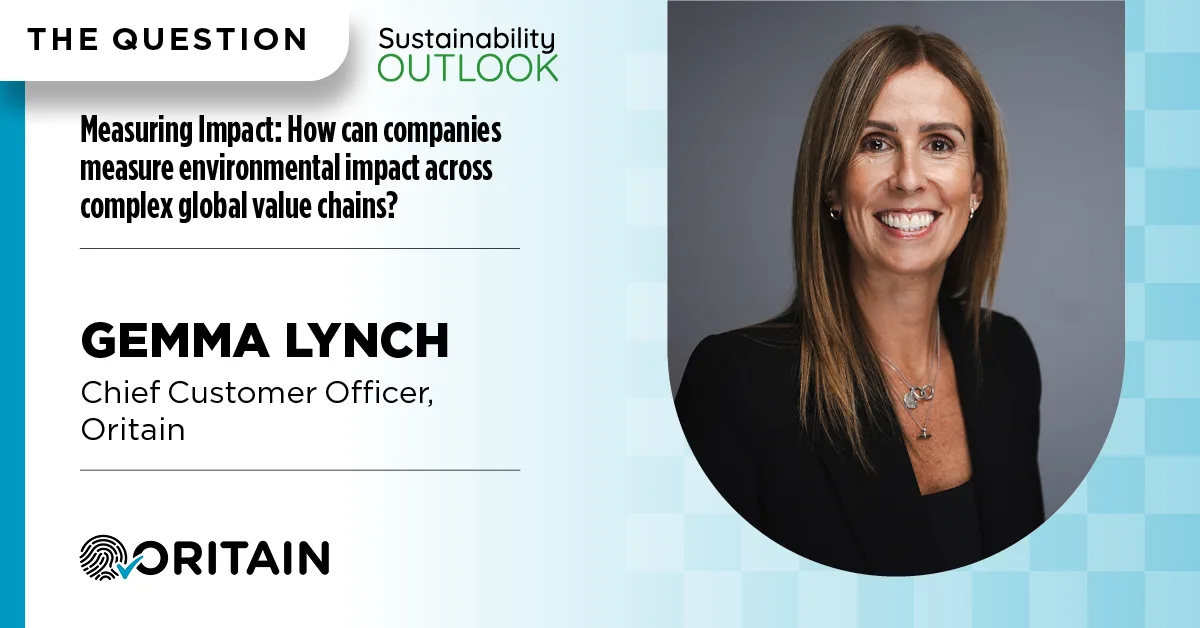
Gemma Lynch
Chief Customer Officer, Oritain
About Gemma Lynch
Gemma Lynch is Chief Customer Officer at Oritain, where she leads the organisation’s sales and account management teams, spearheading strategies and programmes to deliver exceptional client success. Based in London, she joined Oritain in 2025.
About Oritain
Oritain is a global leader in forensic origin verification. Its proprietary methodology verifies origin through multiple analytical techniques, including isotopes, trace elements, and non-traditional isotopes, combined with advanced statistical modelling and a comprehensive global reference database.
The Question is a thought leadership series published on Sustainability Outlook, created to explore the questions shaping climate action, environmental responsibility, decarbonisation, and sustainable business transformation.
Sustainability Outlook features leadership insights and company stories from organisations advancing progress across renewable energy, circularity, responsible sourcing, ESG, sustainable technology, and the transition to a low-carbon economy.
Produced as part of the Outlook Publishing global network of B2B industry magazines, The Question brings focused executive insight to audiences engaged with the companies, strategies, technologies, and decisions shaping a more sustainable future.