




1. Globally recognised standards and target setting: the Greenhouse Gas Protocol and Science Based Targets Initiative (SBTi) to calculate Scope 1, 2 and 3 emissions correctly, consistently, and accurately.
2. Supplier data and traceability to understand upstream impacts, using tools like supplier assessments, sustainability ratings, and raw material transparency.
3. Product-level impact tools such as LCAs and product carbon footprints (PCFs) to quantify the footprint of individual products across their full lifecycle.
4. Governance and materiality so that environmental measurement is embedded in strategy and focuses on the most relevant impacts.
5. Action plans: the goal of measuring and reporting greenhouse gas (GHG) emissions is of course to reduce emissions of your own operations or in the value chain. The Corporate Sustainability Reporting Directive (CSRD) gives good insight in what companies should focus on.
According to Stahl’s ESG Reports 2023-25, the company applies these principles through SBTi-validated targets, supplier sustainability ratings, expanding LCA/PCF coverage, alignment with European Sustainability Reporting Standards (ESRS) and the UNGC, and a double materiality-based ESG Roadmap to 2030.
In essence, measuring environmental impact across global value chains requires science-based methods, high-quality supplier data, product-level footprinting, international standards, and strong governance. Stahl’s publicly reported approach illustrates how these principles work in practice.
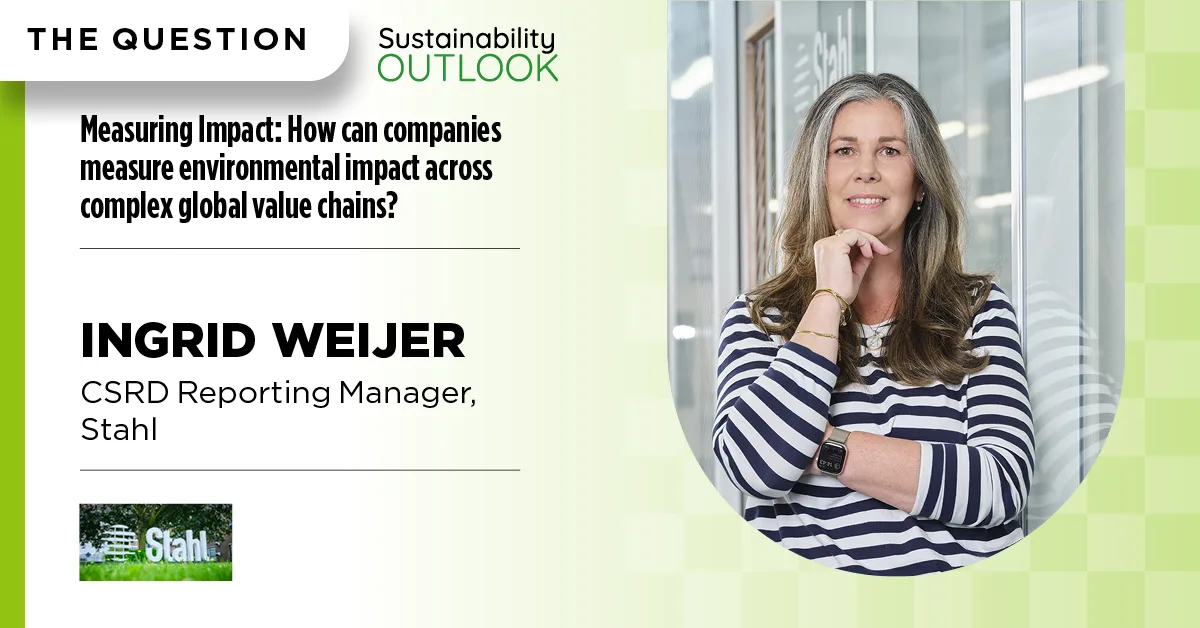
Ingrid Weijer
CSRD Reporting Manager, Stahl
About Stahl
Stahl is a global provider of speciality coatings for flexible materials. Through three business lines – Performance Coatings, Leather Finishing, and Packaging Coatings – we develop coating solutions used across a wide range of consumer and industrial applications, helping enhance the look, feel, and functionality of everyday products.
The Question is a thought leadership series published on Sustainability Outlook, created to explore the questions shaping climate action, environmental responsibility, decarbonisation, and sustainable business transformation.
Sustainability Outlook features leadership insights and company stories from organisations advancing progress across renewable energy, circularity, responsible sourcing, ESG, sustainable technology, and the transition to a low-carbon economy.
Produced as part of the Outlook Publishing global network of B2B industry magazines, The Question brings focused executive insight to audiences engaged with the companies, strategies, technologies, and decisions shaping a more sustainable future.